Worker Bees: Working with Committees

I recently did a presentation on working with committees and sections at the American Bar Association’s Bar Leadership Institute (BLI) in Chicago. BLI is held annually for incoming bar association presidents and their executive directors. I was hired to bring in an outsider and more forward-thinking perspective — that’s always fun! Some of their bar associations have problems with stagnant committees and renegade sections so I addressed those issues in addition to recruiting and working with chairs and volunteers.

I posted my presentation and some notes in PDF format to Slideshare. I was also on a social media panel but we didn’t have slides for that one, just lots of questions. It was standing room only — definitely proof of a desire to figure out how to take advantage of all that social media offers to an association.

The CAE Journey

CAE. Certified Association Executive. Many of my friends outside the association industry ask, “What does that mean exactly?” According to ASAE, it means I’ve demonstrated “the knowledge essential to the practice of association management.” After reading this post, you may decide in my case it should be renamed Certified Association Geek.

The CAE journey gave me a deeper knowledge and understanding of association management, particularly in areas I never had the opportunity to delve into before. Reading the texts while reflecting upon my ten years of association experience gave me a much better grasp of the challenges of leading and managing an association. My mind grappled with a wide range of topics from the minutia of reporting requirements for lobbying to the more interesting concepts of shared leadership and strategic thinking.
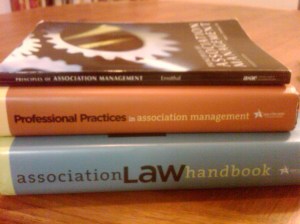
Every week, a new domain entered my life: strategic management; planning and research; leadership; administration; knowledge management; governance and structure; public policy and governmental and external relations; membership; programs, products and services; and public relations and external communications. With each domain came lots of reading, quizzes and a conference call with my study group. I looked forward to my reading time, taking notes as I went, reflecting on what I was reading, what I had seen and how things are changing. I was amazed at how long I would study on weekends. It was a good experience. I knew my knowledge was deepening.

On test day, there was a strange moment about an hour into it when I said to myself, “This is kind of fun.” It might have been the coffee talking, or more likely, I was on a roll with some easy questions. By the end of the four hours, by brain was mush. I was drained. I remember thinking, if I had to bet money, I would bet I passed, but who knows. It was over, all those months of study, over. It was strange putting those books away. The books I had lived with for so long. Then I realized, I have my weekends back and I had a Sierra Nevada Celebration Ale.

Fast forward six weeks and a few days later to this past Tuesday. While running around town that afternoon I got an email from my CAE study buddy, Sandra Giarde, saying the results were out. Our buddy Aaron tweeted he passed. I checked the mailbox on my way home. Empty. The mail was late, really late. Then I had a conference call and couldn’t check the mail for over an hour. Meanwhile three of us who took the exam were emailing back and forth – messages of dread and silliness.

After the call I walked back to the mailbox and there they were — two postal workers distributing the mail among the boxes. “Have you done the other side yet?” My side of the boxes. “No ma’am.” I walked home. My palms were sweaty, my heart was racing.

I waited about 20 minutes and walked back, the mail truck was gone. The mailboxes never looked so ominous. I opened my box. It was full of mail. I quickly flipped through the envelopes and magazines, searching for that one envelope. Oh boy. There it is – a business envelope from ASAE marked “confidential.” Moment of truth. I tore it open with my key. “Dear Ms. Reid:” was all I could read on the first fold. Quickly I turned it over and saw the word “Congratulations!” “YES!” I shouted out, and then thought, oh wait, I better make sure, and quickly scanned and saw enough to know that yes, indeed, I had passed the exam and could proudly put the letters CAE after my name. If anyone had been at the boxes with me, I might have hugged them. I let out another whoop and skipped home with a huge grin on my face. I wonder what the neighbors thought because I really did do several skips.

I wasn’t expecting to be so over the top happy, my reaction surprised me. But I knew that if I hadn’t passed, I would have been so disappointed and devastated, never mind the blow to my pride and ego. All the work, the sacrificed weekends and the new love for my profession – it all paid off in the end.

The letters CAE are validation of what I know and what I’ve been through. But the best thing about this whole process was the journey — the learning and thinking. Everyone’s CAE experience is probably a bit different. We come to it with varying levels of management and leadership experience, areas of expertise, and views on association challenges and opportunities. We approach the study process in different ways. But no matter the final results, going through the process is a huge accomplishment and stands on its own. Passing makes it sweeter.

If you find our industry at all fascinating and would like a rewarding learning experience, I strongly encourage you to study for the CAE exam. I call it a “journey” because it’s like one of those memorable trips to somewhere new and different. I knew where I was heading — the exam. I had my maps — the study guide and texts. I met some people along the way — my study group. But the best part was the studying and learning — being in the experience — the journey.

Agenda Abuse

Reading the paper this past week has reminded me of why it’s so important to train board directors and committee members on good meeting practices.

In Wake County (NC) a new majority was recently elected to the Board of Education. These new members were elected by a tiny percentage of county voters with a mandate to make some serious changes to existing policy – ending the mandatory year-round school calendar and eliminating busing kids to schools (originally instituted to achieve economic diversity). Emotions ran high during the election and especially after when these new faces won the seats of long-sitting board members.

My beef here isn’t with this new majority’s policy positions but rather how they have handled their board meetings, and I’m not alone. The News & Observer editors expressed exactly how many feel.

Taking advantage of their voting power, at the start of the first two meetings they added items and resolutions to the agendas without advance notice to their fellow board members or the public. These manipulative actions didn’t allow any time for public consideration or discussion of their proposed policy changes. They had the votes to ram their policies through but weren’t honest or courageous enough to allow discussion of the issues.

As I read the editorial and expressed out loud my disgust at how poorly the meetings were run, I was reminded about a recent County Commissioners meeting where a contentious issue was resolved by waiting until one of the more elderly commissioners had to use the restroom. Without her vote, the chair could get the motion passed while she was out of the room, so he did.

Is there no training for incoming board members on proper governance and meeting practices? On ethics befitting public servants? Where is staff when this is going on? I can’t imagine any chief staff executive of an association allowing such manipulation of an agenda. Any executive with a spine is going to make it very clear how horribly wrong and ill-advised that is for the long-term. Those items can be put on a subsequent meeting agenda, giving interested parties notice and opportunity to weigh in.

These antics have resulted in policy changes that affect every school-age child and their parents in Wake County – some will agree, some won’t. However, many on all sides are aghast at how these policies were changed. Another result is already clear – a loss of trust and confidence in these new members and their judgment and ethics. It will also be much more difficult for these two sides to come to consensus on future challenging issues. Alas, I guess that’s politics.

This disturbing story reminds me of how critical it is to train our board and committee members on governance and meeting practices that encourage transparency and thoughtful deliberation. Ideally all our leaders would come to the table with good ethics and judgment, and we wouldn’t have to worry about such things. But we can’t take that chance. We need to train our leaders in governing well. They are stewards of the organization and our job is to help them fulfill that role in the best manner possible.

Clues to Authenticity

I love it when conversations begin on Twitter about topics that leave you thinking long after you log out. The other day, Lynn Morton, Cynthia D’Amour and I had a brief exchange about authenticity and how to embed it in an association’s culture. The concept of authenticity is all over the web these days as it’s a required element for social media engagement. This topic especially interests me as I want to work for an organization whose culture breathes authenticity.

But how can I tell if an organization really walks the walk of authenticity? And what does that really mean? Bear with me as I wrestle with this concept.

To me, it means being your true self — communicating and behaving honestly. As the walls between my personal and professional lives have fallen down, it’s been a bit liberating. I don’t have a work personality and an at-home personality, they’re essentially the same – what you see is what you get. Luckily I don’t have any wacky personal foibles to hide. I also understand that many topics are not appropriate for the office — the old “no sex, politics and religion at the dinner table” principle. Does your organization have multiple personality disorder? Does it have different faces depending on the audience, or does it have an honest and consistent nature?

Authenticity often requires self-reflection and review. Am I being honest? Is this really what I think? What are my motives here? Am I sucking up? Am I being defensive? When we’re authentic we learn to listen to criticism and dissent and not overlook the uncomfortable. We face up to reality. This is not always easy, but the right thing to do usually isn’t.

Does your organization go through this process? Is it listening to all its constituent voices, including those that usually go unheard or those that challenge the party line? Has it examined its programs, products and services to determine their true value to members or customers, or is it doing what it’s always done because that’s what you do? Are you dealing with looming challenges and threats, or putting them off by focusing on immediate crises? Authenticity means understanding the real value of your membership for each prospect or member, not relying on the bullet points and marketing copy you’ve used forever.

How does authenticity work with public relations and advocacy? It’s often risky to show your true hand, the other side could take advantage. What about spin and messaging? Our political world is based on spin. How can an association not do that? Yet David Plouffe, Obama’s campaign manager, recently said nothing is more powerful than authenticity, and people have a very sensitive bullshit meter. Which side does your association come down on?

How do you tell an authentic association (or any type of organization) from one that isn’t? I’m still working on a complete answer but here are some ideas:

  • Do they have lots of member evangelists? Or membership testimonials that sound real, not like the brochure?
  • Do they have wide diverse support within their industry and with the public?
  • Are there real personalities with distinct voices speaking on behalf of the association? Is that really the CEO who’s writing the CEO Corner?
  • Do they listen and engage with their members and the public? Or is it only one-way communication?
  • Do they tolerate dissent? Are there negative comments on their blog or in their letters to the editor?
  • Can you tell if their staff is engaged and involved in guiding the association to success, not only the executives, but directors, managers and others?
  • Are meetings accessible to all or are there barriers (financial, technological, procedural) to participation?
  • Are meetings a rubber-stamp process or is there healthy discussion?
  • Does the leadership reflect the membership (or industry) in age, race, sex, etc.? Is leadership stagnant – the old boys club?

This is all very fuzzy, I admit. What do you think are signs of authenticity in an association?

Becoming a Leader – My Top Three

I’m picking up the “three leadership imperatives” meme from Jamie Notter and Jeff De Cagna. I didn’t think I’d be tempted to play along, but then I started thinking about what I’ve expected from myself and aspired to when I’ve been a leader, and what I’ve looked for in others. Thinking back to my years as a restaurant manager, when I was much younger and often challenged, I read and learned a lot about leading others. It was better training than I ever realized at the time and I still struggle to live up to those standards. Perhaps that accounts for my simple and terse directives.

Have a spine.

  • The right thing to do is not always the easy thing to do, but you must do it. Make tough decisions and set high standards. Stand by them.
  • Face up to uncomfortable situations and deal with it — don’t let things fester because you’re not willing to say what needs to be said, or do what needs to be done.
  • Be fair. Don’t play favorites. Make sure everyone follows the rules, including yourself.
  • Admit when you’re wrong. Swallow your pride. Lose the ego.
  • Be honest. Stick to your word. Have integrity. Make your mother proud.

Have a heart.

  • Truly care about others and don’t be afraid to let them know.
  • Don’t manage or lead by fear, that’s not leading. If this doesn’t come naturally to you, think about whether you’re in the right place. Don’t ruin other people’s days for your own ego, get a clue.
  • Treat others with respect. Live by the golden rule.
  • Be conscientious and sensitive to those around you. Pay attention.

Have open ears and eyes.

  • Really listen to what others are saying. Don’t just hear them, listen to them. Pay attention.
  • Look around you, scan the room, and see what’s really happening. Read people — their faces, their body language. Pay attention. Yes, I’m repeating myself, this is important.
  • Never stop learning. Be curious. Don’t get lazy, seek out ways to learn.
  • Don’t be shut in by preconceptions or prejudices. Be willing to see things from different perspectives. Be willing to change.
  • Don’t be handcuffed by the past or the present, imagine many different futures.

That’s my quick and dirty recipe for leadership. Who’s going to tackle this meme next?