
Association Brain Food Weekly: 2.1.16

icy morning 1-24-16

The strong will survive, the smart will thrive. Even busy professionals must set time aside for reading, listening, and learning. Schedule it. Maybe 20 minutes a day, maybe an hour or two a week. You won’t evolve, and your organization won’t evolve, unless you’re regularly feeding your brain with new knowledge and ideas.

One of the ways I’m contributing to the Association Executives of North Carolina (AENC), as a member of its professional development committee, is by compiling a list of professional development opportunities that’s shared in AENC’s weekly newsletter. We only started doing this last week, so AENC’s role (and mine) as an educational curator is still a new one.

This morning, I thought, why not share it here too? So here goes. This week’s list is light on the webinar options-last week’s list included four webinars-so I added a podcast and an online conference. In the future, I’ll also include websites, blogs, and books.

Webinar: Driving Engagement and Retention through Multichannel Personalization

Wednesday, February 3 at 2:00 p.m.

Are you challenged with serving a diverse audience that has different needs and wants? Did you know your audience is leaving behind “digital clues” that reveal what they’re most interested in? Learn how to leverage your website, AMS, and email marketing platform to personalize the audience experience. Learn how to turn website analytics into actionable insight providing constituents with a customized experience. Hosts: Informz, American Eagle. Registration and more information.

Podcast: Leading Learning

The Leading Learning podcast is the only podcast created specifically for leaders and aspiring leaders in the business of lifelong learning, continuing education, and professional development. It’s a ‘must-listen’ for anyone involved in association education. Hosted by Jeff Cobb and Celisa Steele of Tagoras, each week they offer perspectives and actionable insights based on their own extensive experience and interviews with a wide range of learning experts and association leaders. List of episodes and subscription information.

ASAE Online Conference for Small-Staff Associations

Save the date: Tuesday, February 23 – Thursday, February 25

You don’t have to spend money on travel, you can get a full conference experience at your desk: three days of sessions tailored to the needs of small-staff associations covering governance, technology, HR, marketing/communications, leadership, and education. (12 CAE credits)

If your organization offers professional development for association executives, please send me the link via Twitter. I’ll publish a blog post on Fridays with the coming week’s events.

ASAE Annual Exhibitors Miss Another Opportunity

Yesterday, one of my friends started a conversation on Facebook about all the post-show emails sent by ASAE Annual exhibitors. We’re not receiving nearly the deluge of emails that go out before the show, but, once again, many of these emails are missing the mark.

Segment your list.

You scanned badges. You know the names of the attendees who visited your booth during the show, right? So why are you telling someone who didn’t come to your booth:

“Thanks so much for stopping by our booth at ASAE in Detroit. We enjoyed visiting with you.”

How do you think an email like this goes over with an association exec who didn’t visit your booth? I’ll tell you: not well. It’s a sloppy and lazy example of the “spray and pray” tactic.

Next time, segment your list. Send a “thank you” email to the attendees who really did stop by your booth and send a “sorry we didn’t get to meet” email to those who didn’t–but only if they’re truly prospective clients. Have you done that research yet?

Offer value, not another sales pitch.

Only two post-show exhibitor emails in my inbox offered anything of value.

  • One was titled, “How Associations Can Grow Membership and Generate More Revenue,” and linked to a blog post about one of their key take-aways from the conference.
  • The other was titled, “Association Challenges Uncovered at ASAE,” and linked to three posts about those challenges.

As I wrote in my post about pre-show exhibitor emails, you have been given access to an association exec’s inbox—don’t blow it. Use this opportunity to be a resource. Don’t take advantage of that privilege by using it only as one more chance to sell. Most of these people aren’t ready to buy!

Stop relying on drawings.

I understand you want to attract people to your booth, but how qualified are those leads who only visited because they want to win an Apple watch? And you’re still pushing that watch!

I really wonder how many association execs with decision-making authority notice who’s giving away prizes. They’re not going to the expo floor to enter drawings. They’re going to the expo floor to learn about the latest in online learning technology or mobile apps.

Become an ally.

The association executive crowd can sometimes be prickly about vendor outreach—if you’ve seen some of the discussions in ASAE’s Collaborate community, then you know what I mean. I wrote a post about a phrase that might sound familiar to Collaborate regulars: “No Vendors, Please.”

Why do so many association execs have this attitude? Because too many vendors don’t understand how to develop relationships with association execs. And, relationships are the foundation for sales.

Lead with value. Take a consultative approach. Be a source of information and education. Get to know your prospects—their challenges, problems, frustrations, and aspirations. Help them solve problems. Be a positive, valuable member of the association community.

If you’re going to send out blast emails, do it wisely. Sad to say, you will stand out if your emails deliver value to association executives because so few take that approach.

I hope any vendors out there take my suggestions in good spirit because I share them in goodwill. I’m on your side.

(Creative Commons licensed photo by Bark)

The ASAE Annual Exhibitor Email Deluge

association execs don't want promotional emails from exhibitors

Every year, when I register for the ASAE Annual Meeting, I check the box to receive emails from exhibitors. As a writer and content marketer, I like seeing how vendors in my community use email marketing. Some of them do it well, but some, oh boy, they really blow it.

The list ASAE provides to exhibitors includes association execs and staff as well as consultant members like myself. Ideally, an exhibitor would scrub and segment this list because it includes people with a range of positions and needs. For example, a company selling learning management systems shouldn’t waste their time sending emails to a government affairs professional.

The association execs on this list represent a wide spectrum of associations with different membership models, programs, financial resources and history with the exhibitor. Someone who works for a home builders association has no interest in an abstract collection tool. A person who just saw a demo of your system shouldn’t receive a generic email explaining what you do.

Deliver value in return for your inbox privilege.

These attendees have given exhibitors permission to enter their inbox—quite a privilege. Next time you talk to an association exec, ask her how many emails she gets a day. What percentage does she leave unread or delete?

You have a terrific opportunity to be of service and stand out from the pack. Don’t waste this opportunity with a promotional email that only describes who you are, what you sell and what booth you’re in—all forgettable information. Nobody cares about any of that except people in the later stages of the selection process, and they already plan to visit exhibitors who sell what they need.

Instead, use this opportunity to be helpful. Assuming you know your target audience, share something of value. Share educational content that helps execs improve a process, solve a problem, or learn more about a challenge.

For example, if you sell email marketing systems, provide a few tips for getting more emails opened and a link to a blog post that explains more. Sign off with a reminder that you’re exhibiting in booth X at the show and would love to share more tips in person.

Remind attendees why they’re receiving your email so they don’t mark you as spam. Say something like, “You’re receiving our tips because you opted in to receiving emails from exhibitors during the ASAE Annual Meeting registration process.”

Be a good community citizen.

Stick to your agreement with ASAE. I’m guessing you have permission to send this group one email before the show and one email after the show. Comply with that agreement. Just because someone gave you their email address (or business card) doesn’t mean you have their permission to add them to your email marketing list—you don’t, that’s spammy behavior.

If you want to add someone to your email marketing list, send them one targeted email with educational content that helps them solve a problem or improve a process. Near the end of the content, insert your “call to action,” in this case, ask them to opt in to your list. You could say, “If you would like more tips for [the topic of your valuable content], please subscribe to our bimonthly newsletter.” If they don’t opt in, remove them from your list.

If you’re not in the email business, learn more about sending emails that will get noticed, opened, and acted upon. Visit the sites of your colleagues who blog about email marketing, for example, Informz, HighRoad, and Real Magnet. Look for posts on email subject lines, formatting, and calls to action.

You’ve been given access to an association exec’s inbox. That’s a big deal. Now, you have the opportunity to show them what kind of partner you would be. Will you be focused on her needs and help her solve problems, or will you be self-absorbed?

(Creative Commons licensed photo by Bark)

Embrace the Loss of Control

You’re proud of your work. You do it well. And, you do it your way.

Then, one day, someone walks into your office, or into your space, and says, “From now on, we want you to do it this way because…”

Because whatever blah blah blah, you weren’t really listening for a few seconds because what the hell?!?! You’re bristling inside. You’re trying to keep your face under control as you refocus on the conversation.

Control. Ah, that’s the rub, isn’t it? You just lost control. Now you have to do it his or her way. There’s no question about it, they’re the boss.

Confession time.

Ugh, I hate losing control. There, I said it. Thankfully, one of the things I love about working for myself is I’m usually in control of my work, my income, my direction. So when I do lose a bit of control, it’s not such a big deal anymore because I have plenty of control in other areas of my life. Now, I can look at the situation in a more rational way unlike the old days when it would really work me up into a quiet tizzy.

I noticed this change in my reactions recently when a client gave me a list of topics to write about. In the past, I had come up with topics based on what I knew about their audience. I must admit, my first reaction to this list was mixed. I was relieved to see they had this list, but I was also a bit vexed because they weren’t my ideas. Oh my, someone still has control issues.

And I thought I was so evolved.

So I turned it around. This is the new reality. Now I have the opportunity to use my creativity to do something with these topics–some of which are a bit, let’s say, dry. I’ll embrace the restrictions and create something despite them. Or because of them. It’s time to exercise that muscle.

Like the chefs on Chopped who must create a dish using the items in their basket, I’ll take the ingredients handed to me and make them shine. My loss of control has now become my creativity exercise.

<After writing this I was thinking about the chefs on Chopped. Some of them look in the basket and start griping about the ingredients. But some of them just get to work. I wonder which ones go home first?>

Where do you feel restricted? What don’t you control that really gets to you? Rethink your normal reaction. Consider it a creativity exercise—embrace the restrictions, embrace that loss of control, get over yourself and your ego, and produce something that makes you proud despite the loss of control and because of it.

Can you imagine this approach working for you?


Schedule Some Time at the Front Desk

I have a question for association, membership and marketing execs: How often do you pick up the phone at the front desk or in the call center?

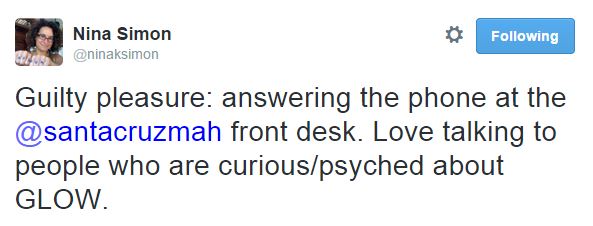
nina simon tweet re working at the front desk

Nina Simon is the Director of the Santa Cruz Museum of Art & History and blogs at Museum 2.0. Her “guilty pleasure” is a smart idea. She also told me she spends about ten hours a month in the galleries with visitors. That’s like a free focus group!

Imagine how those visitors feel when she talks with them. The museum is no longer an intimidating institution – although I’m sure her museum has never been considered that during her watch – her friendly face is the face of the museum.

Those of you who work in a small associations, you’re excused from this exercise since you probably answer the main line as much as anyone else in the office. But if you work in an association that has a dedicated call center or member service team, you probably only receive calls that are direct-dialed or forwarded to you. That’s a shame because you’re missing out on a convenient, cheap way to understand what’s on the mind of your members and other stakeholders.

If you don’t have the time, budget, or inclination to spend a day in the life of your member, then spend 30 minutes every few weeks in your call center. The experience will give you an opportunity to listen, ask questions, and even lay the foundation for further conversation with members you probably don’t know.

You will also set a positive example for your staff by spending time getting to know members. Let them see you on the frontline making the effort to learn about member needs and concerns. Your example could convince them to build similar activities into their week, like calling new members to welcome them to the association and learn more about their expectations, needs, and aspirations. Or, calling “old” members to find out what’s on their mind.

This simple 30-minute task is one you can put into your schedule right now. And it’s a small step that can nudge your organization’s culture into a new direction.

Does Your Organization Pass the Toothbrush Test?

Before Google makes an acquisition, the target company must first pass co-founder Larry Page’s toothbrush test:

Is the company’s product or service used regularly to make people’s lives better?

How does your organization live up to that test?  Do your clients or members depend on something you provide to do their jobs? Does that product/service improve their professional or personal lives? Does it help them reach their goals?

If not, it’s way past time to research your market, talk to people and find out how you can meet their needs in a way that no other organization can.

If you do offer a “golden toothbrush,” can your clients or members get that same product elsewhere? If they can, what makes your offering so different or special? Why would they have a relationship with you?

Does your marketing copy brag about this product? Do you show how it can improve their lives? Do you provide proof – a testimonial or case study?

Attention, loyalty and dollars go to those who deserve it and prove it, day after day.

For more on Google’s toothbrush test, read Google has one essential test when it thinks about buying a company by Max Nisen at Quartz. 

From Purgatory to Pioneers: Rebooting Associations

For many years now, Mitch Joel, president of marketing agency Twist Image, has been manning the lookout post for the rest of us. His blog, Six Pixels of Separation, is a constant in my RSS feed and his podcast is a regular on my phone. Mitch dedicates each podcast to a conversation with someone interesting from marketing, media or another connected world. If you speak at conferences, you’ll like his recent shows with Nick Morgan and Nancy Duarte.

Mitch was a keynote speaker at the recent digitalNow conference in Nashville. In his keynote, as in his book, Ctrl Alt Delete: Reboot Your Business. Reboot Your Life. Your Future Depends On It, he described five massive movements that have changed how we interact with organizations. Unfortunately, many organizations, including associations, haven’t done much to change how they interact with us.

The power of direct relationships

The battle for direct relationships with your members involves everyone else who offers value to them, including your vendor members, media, consumer brands, thought-leaders and others on their screens. Mitch introduced us to someone who might change how we think about connecting with members. Bethany Mota is a teenage video star who shares her shopping “hauls” with 2-3 million fans every day. She’s successful because she knows her community and gives them what they want. Traditional media can’t even compete.

Do you have a Bethany Mota? Partner with people who know how to connect and communicate with your audience — people who can create direct relationships with them and give them what they want. These people may be on your staff or in your membership, but most likely they’re not. You’ll have to create new relationships (and new budget lines) to get them on your team. But you want them on your team.

disruptions facing associations
Mitch Joel at digitalNow 2014 in Nashville
(photo by Bill Sheridan)

Sex with data

Don’t be standoffish. Get cozy and intimate with your data. You can now capture two types of data:

  • Linear data – transactions, searches, email open rates and clicks.
  • Circular data – the social data we willingly put online that paints a picture of our behavior, interests and needs.

The magic begins when you put both types of data together for a deeper understanding of your members and a more personalized experience for them.

Amazon is the personalization king with their website recommendations and their PriceCheck app which tells you how much the product you’re looking at in a store will cost on Amazon. In the process, they’re learning more about you – your location, interests and shopping habits. In return for your data, they provide a better shopping experience. Check out what the Project Management Institute is doing for their members and website visitors. You don’t need an Amazon budget to do that.

Utility or death

Mitch said today’s prime real estate is the smartphone screen. “What are you doing that makes you valuable enough to be on your member’s home screen?” Members don’t really care about you and your promotions, but the old “what’s in it for me” is one marketing cliché that remains relevant today.

Successful for-profit online communities like Doximity for doctors and ResearchGate for scientists focus first on creating utility – tools and services that help their members do their jobs more effectively. That’s why these hugely successful communities have attracted millions in venture capital and millions of members.

Passive vs. active

Know when to make the distinction between passive and active media, and when a member is passive or active online. Press releases don’t belong on Facebook. Members don’t want to be hounded to like or +1 everything they read on your website.

But members do want the opportunity to be active when they’re online in a way that provides value to them. Give them regular opportunities to provide feedback, share an opinion or idea, help make a decision, or participate in a discussion.

One-screen world

No wonder we’re all distracted. Think about how many screens we have going at times: our phone, tablet, laptop and TV. And the Internet of things may bring even more. Yet, we can only watch one thing at a time. The screen in front of us is the only screen that matters. And soon perhaps all these screens will integrate into one screen.

He closed his keynote with a hopeful message: associations are pioneers who will decide how the future of associations will look. Will your association have a cozy relationship with your member in the one-screen world? Come on out of purgatory and into the light where you’ll find plenty of opportunity for those who can keep up and move onward.

disruptions to associations - fade away or become a pioneer
Emigrants Crossing the Plains (or The Oregon Trail), Albert Bierstadt, 1869, courtesy of the Butler Institute of American Art


For-Purpose People and Organizations Will Change the World

We attend conferences so we can deepen our knowledge and relationships. Hopefully we’ll also get recharged and inspired too but that doesn’t always happen. I was fortunate enough to come away from the 2014 digitalNow conference in Nashville both recharged and inspired thanks to being surrounded by smart people, good friends, savvy conference organizers and the very cool city of Nashville.

After a bountiful breakfast from the talented kitchen at the Omni Nashville, digitalNow attendees entered the theater at the adjoining Country Music Hall of Fame and Museum to await the conference welcome. I was expecting to see Hugh Lee and Don Dea of Fusion Productions, the brains behind digitalNow, walk on stage but instead the theater lights dimmed and I heard the opening chords of a familiar song. A spotlight shone on Nashville residents Gordon Kennedy and Wayne Kirkpatrick playing a little something they wrote for Eric Clapton, Change the World.

Gordon Kennedy and Wayne Kirkpatrick opening digitalNow 2014 (photo by Bill Sheridan)
Gordon Kennedy and Wayne Kirkpatrick opening digitalNow 2014
(photo by Bill Sheridan)

…if I could change the world…

digitalNow’s opening keynote speaker, Adam Braun, founder of Pencils of Promise, is changing the world, one pencil, one school and one child at a time. By the time Adam turned 25, he had already been a Wall Street child prodigy, Brown University graduate, shipwreck survivor and world traveler.

During his travels, he asked a child who was begging in the streets of India, “If you could have anything in the world, what would it be?” The little boy answered, “A pencil.”

The average pencil holds 45,000 words, Adam said. It provides access to self-education and unlocks a child’s curiosity and imagination. Adam started handing out thousands of pencils in his backpacking trips across six continents. Now, his organization, Pencils of Promise, builds schools (200 so far!), trains teachers and provides scholarships to students.

Adam shared several lessons he learned along the way – lessons that apply to both people and organizations.

We are not in the non-profit business. We’re in the for-purpose business. Adam hates the term “non-profit.” He believes “non-profit” is a negative term that doesn’t define our work and strips our organizations of their value. Pencils of Promise is “100% for purpose.” We all know that “non-profit” is merely a tax status, but I wonder how many organizations excite their community with their purpose.

When your members think about your association, do they only think about the products and services you offer, or do they think about being a part of a movement that is changing the world?

Nothing is more powerful than discovering purpose. Adam shared the journey that led him to discovering his purpose. Purpose, not possessions, gives life meaning. However, many of us are so busy living our ordinary lives that we don’t think about purpose. How can associations help members find and live lives of purpose?

True self-discovery is on the edge of your comfort zone. If your dreams do not scare you, then they’re not big enough. When you have big goals and do scary things, you end up becoming a much more grounded and happy person.

I can vouch for that even though I figured it out much later in life than Adam. Although I have very risk-averse genes, I moved across country twice, started my own business, climbed Angel’s Landing in Zion National Park and, most recently, climbed over exposed slickrock domes, chimneyed in a slot canyon and rappelled down cliffs in Capitol Reef National Park.

I don’t list these experiences to brag. That’s not my motivation — although I do admit to still bragging about Angel’s Landing since I gave myself a 30% chance of doing it. I want to encourage you to go for the gusto. Prepare yourself and do it, whatever “it” is. Even if it makes you very uneasy. You’ll be a changed person once you stretch your comfort zone and overcome your fear.

Associations are on the edge of their comfort zone right now dealing with new ways of associating, learning and communicating, new technology, new competition, and new expectations. This is also a time of new opportunity. Associations who push through their fear will become stronger and better positioned to be agents of transformation for their members.

The quality, not quantity, of an engaged and loyal following is key. It’s not about converting the masses; it’s about finding the one person in the room whose eyes light up. Adam told the story of one of their “torchbearers,” Chelsea, the only person who showed up at one of their meetings. She became a huge supporter and organizer. Are you paying attention to the people in your community whose eyes light up when talking about your mission? Not just the usual suspects but those on the periphery?

Take advantage of the belief people have that they can change the world. I wonder, do GenX and Boomers still believe they can change the world? I know some of us do. The members on your board better believe it too.

Thankfully, Millennials believe they can change the world. And Adam calls the generation after the Millennials, “Generation Why Not.” If younger people don’t see your association as a community where they can make contributions and create change, they’ll find another where they can.

Build a movement and mobilize people by making them the heroes of the journey. Stop talking about the association and start talking about the work your members and volunteers do – how they are creating (or can create) something bigger than themselves.

Find ways to make people feel like important members of a purposeful community. Adam gave business cards to early supporters of Pencils of Purpose. They built a digital platform where torchbearers can tell their own stories. They tag contributors’ name on social media platforms to show them (and their friends) what they’re creating.

Speak the language of the person you want to become — your future aspirational self. Use the language of self-realization, for example, instead of saying, “We’re hoping to build a school,” say, “We’re building a school.” Guess what happens? People will think of you in those aspirational terms and connect you with those who can help you do it. Say it and make it so.

Do you want to help change the world? Together, we are building a classroom for kids who never imagined they would sit in one. We’ll give little girls and boys the chance to unleash their minds and escape the worst kind of poverty. Visit http://www.thedigitalnowpromise.com and contribute what you can to digitalNow’s team fundraising page for Pencils for Promise.