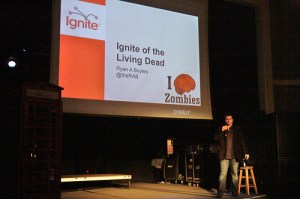
Ignite Your Conference!

Last night I attended Ignite Raleigh. It’s been described as a technology variety show but that description doesn’t do it justice. Here’s how it works.

Lisa Creech Bledsoe aka twitter/glowbirdThere were 19 speakers. Each one gets five minutes and 20 slides. The slides automatically change every 15 seconds. They can speak about anything they want. They are chosen by the community. We voted for the speakers and topics we wanted to hear. Once we registered on the show’s web site, we received ten votes. We could give all ten votes to one speaker, or spread them out any way we chose. And if we changed our mind, we could take our vote back. The community chose 15 of the speakers and the organizers invited four speakers.

It’s a fast-moving show hosted by an emcee who kept it lively. At the end of five minutes, you are rickrolled off the stage. Some of last night’s topics:

  • A Day in the Life of a Meteorologist
  • NerdGirls Unite! Fact: Women Don’t Have to Be Lame
  • How to Save $100 with a DIY Home Energy Audit
  • 20 Little Know Facts About Sex & Pleasure
  • What Happens to Your Digital Identity After You Die
  • 13 Reasons Women Should Take Up Boxing
  • Everyone Needs a Dumb Guy
  • Mayberry Modernism: Why the Triangle is America’s Hotspot for Way Cool Houses
  • Ignite Night of the Living Dead
  • Why My Cat Can Get a Job Before You

Ryan Boyle aka twitter/therabAs you can see, it’s not a tech geek night, unless you call PowerPoint techy. It was fun and educational. It brought together about 500-600 people for a free night of entertainment.

Why would an association want to do this at a conference?

  • It’s a low cost (or free) night of entertainment for attendees where they can hang out and have fun with others.
  • We get to see another side of fellow members.
  • We also get to see members in the spotlight that might not normally get that exposure, a new set of faces.
  • It will be talked about. Believe me, this type of event gets lots of buzz – tweets, Facebook posts and lots of blog posts, lots.
  • It’s a great way to experiment with crowd-sourcing.
  • You can offer something to those members (perhaps younger, perhaps easily bored) who aren’t interested in your usual evening fare.

emcee Zach Ward aka twitter/zachwardWhat does it take?

  • Organizers – Ignite Raleigh was organized by the three man team of OurHashtag with the help of a volunteer coordinator.
  • A large room with a stage, screen and two mics (one for the emcee, one handheld mic for the speaker). The venue last night had some bridge chair seating in the front and in the balcony, but most of it was standing room only.
  • Voting tool – Ignite uses Uservoice on their web site.
  • Registration tool like Eventbrite – Ignite Raleigh was free and they closed registration when they reached the room’s capacity plus an additional no-show allowance.
  • Technical help to run the automated Powerpoint, sound, lights, video camera, livestream (optional) and photography.
  • Volunteers to check folks in, do crowd control and assistance, act as runners and shuffle speakers on and off stage.
  • An entertaining emcee – red tutu not required.
  • Sponsors to cover expenses – Ignite Raleigh ran short videos at the beginning of the night and at intermission and gave them lots of stage/on site love but not the microphone.
  • Brave speakers.
  • Cash bar for the audience.
  • Marketing in conference materials and through social media.

Instead of going to an association awards dinner, I would much rather attend an Ignite-like evening, and I’m a Boomer/Gen Xer (Generation Jones), imagine what your young members would prefer. This is a great alternative to your regular evening programming for those who frankly aren’t interested in what you’re offering, or can’t afford it.

UPDATE: After posting this I learned from Shelly Alcorn that the California Society of Association Executives will be doing an Ignite night at their annual conference. Can’t wait to hear how it goes!

What It Takes to Plan and Host a Conference in Only 46 Hours

In how many hours? Yes, 46 hours, according to my calculations. Sounds impossible? It can be done. As a matter of fact, it happened this week after the American Society of Association Executives (ASAE) had to cancel its annual Technology Conference.

The conference was to start on Wednesday with exhibitor move-in and pre-conference workshops, but DC was still under nearly two feet of snow from the weekend’s storm and was due to get one foot more in blizzard conditions on Wednesday. Airlines were already canceling flights. Some attendees and exhibitors got to town on Tuesday before everything shut down but many were still stuck at home. Even many of those based in DC were still snowbound due to impassable roads and no Metro or train service above ground.

On Tuesday morning ASAE announced via Twitter that it would make a decision by 3:00 p.m. as to whether the conference would be canceled. That’s when the member community started working on Plan B. Later ASAE announced their decision to cancel, the right thing to do considering the conditions. Immediately after, Maddie Grant and Lindy Dreyer of Socialfish blogged about UnTech10, Plan B, an unconference that a team of members had quickly started organizing.

On Thursday, 75 attended UnTech10 in person and 425 attended virtually via a live stream (live webcast) of the programming. I didn’t have the time or budget to go to ASAE’s Technology Conference, but now I was able to “attend” UnTech10 for several hours on Thursday. It was an intellectually stimulating afternoon, time well spent. On Friday, although there wasn’t an on-site component, a full day of webinars was scheduled for the virtual audience.

What do you need to pull off something like this? Here’s what I learned from Maddie and Lindy’s post about organizing it.

You need word of mouth (or mouse) marketing. Most of the marketing for UnTech10 was done via Twitter. A hashtag for the conference was created (#UnTech10) so members could follow that stream of tweets to keep updated. Keep your tweets short enough so that others can retweet them. Vendors also notified clients via email.

Create a Facebook fan page. Although UnTech10 didn’t do this, I saw several references to UnTech10 in my Facebook News Feed as friends shared the original Socialfish blog post.

Create a buzz-worthy email and ask your members to forward it to those they know in the industry or profession. Give clear instructions on how to register and compelling reasons on why they will want to participate. Don’t scare them off by using only technical lingo. This is user-friendly technology, like watching TV!

Contact affiliated or friendly organizations for help in spreading the word. Provide copy and links that they can use to share the news. If you create a sense of buzz and excitement about something, it will go viral if you make it easy for others to help you.

Create a central hub for handouts, schedule, instructions on how to participate and an archive of webcast segments. Content experts were asked to submit program ideas to a wiki. The organizers created a full day of on-site programming (that was live streamed) for Thursday and a full day of webinars for Friday.

Most importantly, you need a community – good relationships with vendors who can help you pull it all together – vendors that will contribute staff to work with you and free services and/or funding for other expenses. This organizing team will take charge and make it happen. According to Maddie, each company on the UnTech10 team had an area to oversee:

You can do this. You can do this if your event is threatened by weather or other unforeseen circumstances. You can certainly do this if you have more time than the UnTech10 team had. They were able to pull it off because they had relationships based on existing trust. Trust that everyone would work together and do their best for the right reasons. The team stepped up and made something excellent out of an unfortunate situation and provided a meaningful experience for our community — an experience that many of us would not have had otherwise.  Because of the generosity and hard work of my fellow members, now I had a chance to grab several hours of education and online networking with other members. This is what a real community does. Does your association have that kind of community?

Learning to Talk and Walk at the Same Time

A Twitter friend of mine, Jeff Bailey, something of a presentation guru himself, told me about a two-day speaking class, Powerful Persuasive Speaking, taught by Alan Hoffler. I don’t think any of us can ever learn enough about the science and art of communicating, so I quickly signed up.

I became more aware in a few hours of my speaking shortcomings and strengths than I ever could have imagined, and then spent the next two days learning how to correct my bad habits (that I didn’t even know existed!) and become a better communicator. Our teacher Alan was a walking talking example of an engaging and effective speaker and he was also a fun, patient and knowledgeable instructor.

We had two rules to bear in mind:

  • It’s not about me, it’s about the audience.
  • Mind the gap — there’s a huge difference between what I’m feeling while speaking and what the audience is experiencing.

I definitely knew the first rule, although there have been a few times when it was hard to get out of my own worrying head and into the audience’s, especially when things out of my control disrupt my carefully prepared plan. I had experienced the second rule (the gap) and never quite believed it, but now I have the film to prove its truth. Sometimes if our mind is in turmoil and we think we are absolutely dying up there, strangely enough we can appear poised and confident to the audience – a huge gap in perception versus reality. Why do we appear so confident? It’s because we have the skills – either learned or innate. We are connecting to and engaging the audience. It seems almost magical at times.

We learned about posture, arm placement, gestures, eye contact and movement. Yes, it is hard to walk and talk at the same time! It actually takes practice to do it in an effective way. Thankfully, we learned that much of this is similar to muscle memory. If we practice the skills, soon they become natural to us and we can build our presentation on top of them. I thought back to when I learned to figure skate and the hours I practiced school figures using different edges. Boring! But those skills became part of my muscle memory. Without having them as a base I couldn’t have done the pretty spins and jumps.

Another thing happened in class, something that wasn’t included in the program description. We started as a group of eleven strangers who were feeling a bit nervous, anxious and vulnerable about speaking, totally unprepared as to content (improvising in fact) in front of each other, and being filmed while doing it. By the end of the second day, we had bonded as a group that went through a discovery and learning process together. We felt comfortable pointing out each other’s mistakes and strengths. We became interested in each other’s professional paths. Some of us spoke of meeting regularly as a group to continue practicing our burgeoning skills.

Learning and growing is always more rewarding when doing it with others – whether it’s a class, study group, discussion group, workshop or retreat. Seeing the excited spark in someone’s eyes or noticing how their body moves to the edge of their seat leaning into a conversation – that can be infectious in the best way possible. I’ve always been motivated by opportunities to learn and find ways to make it a regular part of my life. How do you find ways to learn and grow with others?

Sometimes You Know More Than You Think You Do

A few months ago Scott Oser asked me if I’d like to be a presenter for a webinar series for association staff who want to learn how to implement social media tools at their organization. I don’t consider myself a social media “expert” but I do know that since immersing myself in social media over the last year and a half, I do have a lot to share with others in my profession. Since I have never presented via a webinar before, and never even presented on social media in any format, I was tempted (for just a second) to pass, but I wanted to stretch myself, so I accepted.

I’m sharing the presentation duties with my new friend Ted LaBarbera. Ted’s the web editor at the American Association of Advertising Agencies in New York. Typical of social media relationships, Ted and I have never met in real life, but I’m sure we’ll enjoy sharing a beer together one day. We’re taking turns on presenting — I’m the lead for two of the webinars (the intro and LinkedIn) and Ted is for the other two (Facebook and Twitter). When we’re not leading, we act as color commentator for each other.

Last week I took the lead on our first webinar — Social Media 101 for Associations. It took a while for me to get the content nailed down. I wanted to focus on the big picture — how social media efforts must align with an association’s strategic plan, the mindset (or culture) required to be successful and the first steps to take. It was way too much content for 50 minutes but we managed to fit it all in, barely.

I posted my PowerPoint presentation and a PDF with session notes on Slideshare in the hopes that my approach will help somebody’s organization or business.

It’s a strange feeling to talk into a phone to an audience that you can’t see and that can’t talk back. But I did enjoy the experience, not as much as speaking to real people in front of you, but hopefully what I had to say made a difference to them. And like speaking in real life, I was wired for about three hours after!

If you are ever offered the chance to do something out of your supposed comfort zone and you know that deep inside you have what it takes, or, with a little work, could have what it takes to do the job, than do it. That’s my advice for the day!

Twitter’s First Association Chat

The first association Twitter chat (#assnchat) was held on Tuesday, May 12. Jeff De Cagna (@pinnovation) came up with the idea, spread the word and moderated the chat. I volunteered to go through the tweet twanscript (oh, sorry, couldn’t resist!) and post a synopsis. Although we did not solve all of today’s association problems, we did have a good conversation about some of the issues our industry is facing and how we can begin to tackle them. Here is an outline of the topics discussed — it’s a bit rough but will give you a sense of the conversation.

Online communities as a threat to associations

  • Information – members get news and information more quickly from online peers and sources and have access to experts online.
  • Networking – associations are not usually the conduit for members’ networking online.
  • Online as alternative to the status quo of associations
  • Some associations don’t think their members are using social media, but you need to survey members to determine if that perception is in fact true, you may be surprised at what you learn.
  • Even some participants are questioning their future membership in industry associations because of the benefits (professional development, networking, information, news) received freely online.

Solutions to the online threat

  • Do associations really know what members want? Or do we and/or our boards assume we do? Ask your members, “what could we do that would make you a member for life?”
  • Demonstrate value above and beyond what people can get elsewhere. What’s indispensable?
  • How does the association enhance/augment a member’s social networking activities with other value? Association as a starting place to meet peers or the glue that holds folks together — online or face-to-face can enhance those relationships, should have both channels, members can participate in ways that work for them.
  • Be in the social networking outposts (Facebook, Twitter, LinkedIn) while linking to a home base for members on your web site – one supports the other. Enable associations to become the conduit for people to find each other. But why should members pay for this when they can do it themselves online? Because associations are better at organizing face-to-face meetings and events?
  • Successful associations will focus on building community, being relationship brokers and serving as a conduit.

Content as a membership value

  • Associations as holders of content (experts), “legitimizers” of content (still true?), conduit/forum for members to deliver their own content/expertise
  • Who creates content?
    • Members as knowledge/content creators – associations must encourage and facilitate that; enable members to become creators, but allow others to comment, etc. Association as curators.
    • Some associations do not have the staff resources to create content, must rely on members/others.
    • Social media can be used to co-create with contributors (not necessarily members) to build trusted markets of exchange.

Members-only content

  • Still viable? Some say no, not a useful construct.
  • How to determine what lives behind the member wall? Associations first need a social media strategy to determine that.
  • Don’t build a wall, create a fishtank – provides transparency with the membership and the profession, shows how members engage with association. Create a filter to “clean” the process as you go — new blood in staff and leadership, new initiatives, trying to break new ground. Pressure to make changes is greater outside the fishtank than inside.

Why aren’t associations changing?

  • Fear of change and the unknown, risk-averse, bureaucratic nature, slow moving, slow to critique or envision alternate futures
  • Lack of understanding drives decision makers to want more assurances, research and risk management
  • Members want safe networking with peers and safe experimentation with leading edge tools — safety as a form of deep support (AAA and AARP – their value propositions are built on safety)
  • Need to create a safe, trusted environment in which people can make sense of things, access advice and experiment
  • Education is necessary during periods of change

Membership dues revenue model – viable in future?

  • Are associations in danger of following in the footsteps of the newspaper industry? Yes, because we won’t give up what holds us back – closed membership.
  • Where then does revenue come from to support advocacy, operations and other member services?
  • If content is open to all, what are members paying dues for?
  • Social media as possible revenue source — advertisements, sponsored webinars/podcasts/videos, tie-in with events, user-generated content
  • Or, more likely, social media won’t be arevenue source but a way to build new capabilities that create revenue. Associations as a unique, personalized experience, as deep support for member.
  • Extract the value of the interaction between activated network and content.
  • Possible revenue source – product/content development
  • Perhaps a membership model that grants access to info/events based on participation level, those who give more, get more.

Tools for communication

  • Yammer for internal communications – have to have an email address from the same domain to use Yammer, otherwise you can’t login; great for cutting across departmental silos.
  • Cubetree
  • Tweetgroup – groups and attachments, wonderful application with desktop client
  • iPhone apps – American Bar Association has one for its magazine, American Booksellers Association

Questions for future chats

  • Does anyone see associations struggling to deal with the way different generations want to interact? Face to face vs online?
  • With high demand on staff in small associations, how do we get our members to support and feed content creation?

Participants

AddyKujawa, alisonharle, BeccaFlach, CharmsS, DeirdreReid, desabol, eventpublisher, j8nd, jcrosby4, Jeffhurt, jeremygriffin, jmoonah, joerominiecki, JoeStella, karenaltes, kevinpatrick, kristildonovan, maggielmcg, MissLynn13, pinnovation, rharris, rjohnston, sgiarde, unklbuck

The next #assnchat will be Tuesday, May 19 at 2:00 p.m. Eastern (11:00 a.m. Pacific). You can follow by going to Tweetchat or Tweetgrid and following #assnchat, or in Tweetdeck you can create a search column for #assnchat.

Everything I Know About Social Media, I Learned As A Restaurant Manager

Ok, not entirely true. I’ve learned a lot from books, blogs, Twitter, webinars and practice. But once during an Awareness Inc. webinar David Carter said, “Everything I learned about social media, I learned as a waiter.” I don’t think he expected anyone to put as much weight into that sentence as I did. It dawned on me that part of the reason I took so wholeheartedly to social media is that I’ve been operating with its principles for years. I’m going to examine some of these principles in restaurant terms, but they apply to any organization.

Word-of-mouth marketing

It’s the most effective (or potentially destructive) marketing tool for restaurants, as it is for all companies and organizations. Being the hot new place is great, but the buzz will fade unless we back it up with food and service that’s worth talking about, for years. We want to be the place that tourists mention to others traveling to our city, that friends talk about at parties, and that colleagues discuss at work. We are also aware of the lasting power of negative word-of-mouth.

Integrity at all costs

Never ever lie or mislead your staff or guests. Be honest and trustworthy. If your salmon is farmed, admit it, don’t pretend it’s wild. If you anticipate an hour wait for a table, disclose it, don’t fool them into thinking it will only be 30 minutes. Don’t date your cocktail waitresses. Have high standards. Do what’s right, always.

The customer is right, even when they’re not

We cringe at that old phrase, but the customer’s perception is their reality. You have to start from there. If someone has a bad experience and isn’t satisfied with our response, we have just created a walking nightmare. However, we can turn them into a raving evangelist if we figure out the right thing to do for them, and then do a little more. This is no time for egos. It’s about them, not us. How do we fix it?

It’s all about relationships

What does every restaurant want? Repeat guests. One visit is appreciated, but we can’t succeed for long if they only come once. We can make that easier if we create relationships. Be a personality not a brand.

  • Welcome your new guests. They’re taking a chance on you — make them feel appreciated and comfortable.
  • Nurture your regulars — your evangelists. They will do your marketing for you –- reward them for that. Stroke their egos in front of their friends. Give them special treatment.
  • Treat everyone the way you would like to be treated. Even better, the way you would like your grandmother to be treated – the golden rule.

Look and listen

  • Scan the room. Are your guests happy to be here? Look at their faces, their body language, their interactions, and their tables. Anticipate their needs –- that’s the key.
  • Listen to what people are saying about you and respond to it, the good and the bad. Accept criticism and learn from it. Put your pride and ego aside and make things right.

Your staff determines your success

  • Trust your gut when you hire staff. Do they want to learn? Do they really like people? Are they positive personalities? Do they care?
  • Educate your staff. Create a culture of knowledge that they will share with guests. Encourage and recognize those who demonstrate that knowledge. We had oyster-tasting contests, wine and beer seminars, and fish school. We made it fun and ended up with the smartest and most loyal wait staff in town.
  • Trust and empower your staff. Give them guidelines to follow so they can make customer service decisions on the spot. If you’ve done right by them up to now, they’ll do the right thing.

Pay it forward

Be a good citizen. Give back to the community that supports your business. Join your local chamber or business group. Find a cause that you and your staff feel passionate about and partner with that organization to raise funds and awareness. Show the world that you are more than just a brand or a storefront; you have a personality and a heart.

Were you thinking about your customers or members when you read this? If not, go back and translate these restaurant scenarios into your organization’s perspective. Before incorporating social media into your culture, make sure you are comfortable with these principles. They’ve been around forever, but in the new Web 2.0 world, you can’t succeed without them.

New Members and Twitter Rookies – Why Do They Leave Us?

Nielsen Online reports that more than 60% of the people who sign up for Twitter leave within a month. This finding provoked lots of conversation on blogs and listservs about whether Twitter is a fad or here to stay. Some used the study to validate their perception that Twitter isn’t worth their time.

I’m not surprised by the low retention rate. New users of Twitter leave for the same reasons new members leave associations, online communities, chambers and other groups — they never learned how to use Twitter or their membership effectively, therefore they don’t see or get the value.

  • They enter the “room” and can’t find anyone to talk to. They don’t know how to find the right people to follow.
  • They fall in with the “wrong crowd.” There are a growing number of spammers, multi-level marketers and idiots on Twitter. They follow everyone, hoping someone will follow them back. They’re only after numbers and provide nothing of quality. Many new users follow them or people who only broadcast, never interacting, like celebrities. The new user remains lonely in a crowded room and hears nothing of substance.
  • They don’t look to see how others use Twitter effectively. They don’t know what to say and, believing all the hype about Twitter, they talk only about what they’re eating for lunch. Nobody cares. Or they use Twitter as a therapist and whine about their life or crazy siblings. Nobody cares. Or worse, they become broadcasters themselves, talking only about their company or product. Nobody cares. Don’t answer the Twitter prompted question — what are you doing? Instead tell us what you’re thinking about, what you learned toda, or what you read that’s worth sharing. Aspire to be interesting — easy to say, hard to do.
  • They don’t know how to manage the barrage of tweets. They don’t have time to read it all. Besides, so much of it is crap. Yes, it is, if you follow the wrong people and don’t have tools, like Tweetdeck, to help you manage your updates.

These poor souls never learn how to use Twitter as a knowledge and networking tool. They don’t get any value from it and they leave. Who can blame them? I’ve written about this before — it’s the same challenge with new members. If we don’t teach them how to use their membership appropriately and effectively, they’re not going to get the resources they need or develop the relationships they desire. We won’t meet their membership expectations and we’ll lose them after one disappointing year.

There is a great opportunity here for organizations to be their members’ social media coach and teach them how to effectively use not only Twitter, but also RSS readers, Facebook and LinkedIn.

If you know of someone who’s struggling with Twitter, tell them about your experience – how you learned to use it and what you get out of it. The web is full of resources about Twitter. I think one of the best directions you can point them is Darren Rowse’s TwiTip blog. He and his guest bloggers focus on how to use Twitter effectively. Or, for a more amusing (but helpful) introduction, show them the Twitter Rule Book.

Twitter has turned out to be more educational and rewarding for me than I ever expected, and my passion (there, I said it) for Twitter reminds me of the same passion some of our members had for my old association. Once they figured out (or were taught) how to “work” their membership, their opportunities to learn and develop relationships were unending. Many of those members learned from others – they had unofficial mentors. Maybe it’s time for us early adopters to be Twitter mentors to others, to share how we use it and help them find the same rewards we have. Reach out and save a Twitter Qwitter!

Becoming a Leader – My Top Three

I’m picking up the “three leadership imperatives” meme from Jamie Notter and Jeff De Cagna. I didn’t think I’d be tempted to play along, but then I started thinking about what I’ve expected from myself and aspired to when I’ve been a leader, and what I’ve looked for in others. Thinking back to my years as a restaurant manager, when I was much younger and often challenged, I read and learned a lot about leading others. It was better training than I ever realized at the time and I still struggle to live up to those standards. Perhaps that accounts for my simple and terse directives.

Have a spine.

  • The right thing to do is not always the easy thing to do, but you must do it. Make tough decisions and set high standards. Stand by them.
  • Face up to uncomfortable situations and deal with it — don’t let things fester because you’re not willing to say what needs to be said, or do what needs to be done.
  • Be fair. Don’t play favorites. Make sure everyone follows the rules, including yourself.
  • Admit when you’re wrong. Swallow your pride. Lose the ego.
  • Be honest. Stick to your word. Have integrity. Make your mother proud.

Have a heart.

  • Truly care about others and don’t be afraid to let them know.
  • Don’t manage or lead by fear, that’s not leading. If this doesn’t come naturally to you, think about whether you’re in the right place. Don’t ruin other people’s days for your own ego, get a clue.
  • Treat others with respect. Live by the golden rule.
  • Be conscientious and sensitive to those around you. Pay attention.

Have open ears and eyes.

  • Really listen to what others are saying. Don’t just hear them, listen to them. Pay attention.
  • Look around you, scan the room, and see what’s really happening. Read people — their faces, their body language. Pay attention. Yes, I’m repeating myself, this is important.
  • Never stop learning. Be curious. Don’t get lazy, seek out ways to learn.
  • Don’t be shut in by preconceptions or prejudices. Be willing to see things from different perspectives. Be willing to change.
  • Don’t be handcuffed by the past or the present, imagine many different futures.

That’s my quick and dirty recipe for leadership. Who’s going to tackle this meme next?