Conference Creativity Rooms

Although I didn’t participate in today’s #assnchat about ASAE’s Great Ideas Conference, it still inspired a blog post. Thank you, KiKi! Here’s why.

conference creativity rooms

I must confess I never went into the creativity rooms at Great Ideas. I peeked into one, but it looked like a dolled-up regular meeting room to me. Maybe I missed something. Maybe I missed it completely. I thought I saw toys on the tables. Or did my eyes deceive me? It’s a shame I didn’t go in and explore, but the timing was never right.

And table toys don’t do much for me. I swear I’m not that serious a person. I’ve attended sessions with group activities centered around toys or other building-block-type things. It’s forced fun for a while. People relax a bit and some get really competitive: “Ours will be bigger!” Perhaps playing with toys shifts our mindset from serious office mode to relaxed engaged conference mode. And, yes, we’re using our creativity, but it seems so forced. And passé, isn’t it? Ok, call me a kill-joy. Then, after a rousing round of construction, the hubbub dies down and we sit passively for the next 30 to 40 minutes listening to the speaker and sneaking glances at the silly-looking fort on our table.

The association professionals in today’s Twitter chat had plenty of great ideas (heh heh) for conference creativity rooms and I even have a few of my own.

Exercise: @AssnMetrics would include “some piece of exercise equipment to put my body in a different state from just sitting.” That reminded me of the Snap Learning Spot sponsored by the Canadian Tourism Commission at Great Ideas where my friend Rob Barnes rode an exercise bike for 35 miles while listening to a micro-learning session. His miles on the bike also raised money for charity. I can imagine a creativity room with a bunch of exercise bikes (or treadmills or ellipticals) for people who want to chat while firing up their mind and body. Maybe some air hockey too. If you rather get outside, the room could be a meeting place for people who want to take scheduled or random walks or hikes.

F&B: The Canadians also served poutine at one point during the conference. I’m sorry I missed it! But, that leads me to my second creativity room feature – food and beverages. @SarahJanetHill and @strattonpub had the same idea. Definitely provide coffee, tea, water and other healthy beverages. Our brains need fuel. Have sign-ups for sommelier- or Cicerone-led wine and beer tastings at the end of the day. The food for the room could be made by people attending mini-cooking classes.

Mini-classes: Why stop at cooking classes? People can sign up in advance to teach people how to knit, play Texas Hold ‘Em or the acoustic guitar, or whatever. 

Arts and crafts: @SarahJanetHill said she likes “playdoh or pipecleaners or something to keep my hands busy. Helps keep my brain engaged.” @ASegar added, “craft paper, scissors, glue.” Who doesn’t like arts and crafts? Let’s make lunch centerpieces, art projects, lanyards or badge decorations – it’s like camp!

Puppy room: @k8doyle suggested this brilliant idea. But where do the puppies (or kitties) come from? Why the Humane Society or SPCA, of course! They can talk to folks about fostering pets, pet care, and other topics.

Music: @ToeKneeRay wants music and I agree. Even at a low (and adjustable) volume, it will energize people. Live music throughout the venue would be even better, if you can afford it. 

Furniture: @strattonpub requests “comfortable seating for solo and group work, lots of natural lighting, warm colors/décor.” I’d add all kinds of plants too – ferns, cacti, succulents, leafy plants, etc. @craigsorrell would like “a room of rocking chairs so you can sit and chat with attendees.” I envision a big room with some private spaces for those who need a bit of solitude. A room with a view would be ideal. Or a few rooms scattered throughout the venue, each with their own character.

Shazam: Wouldn’t it be cool to go somewhere and let your creativity and intellect go crazy in conversation with other attendees? Maybe speakers would pop by and ask questions that encourage wild thinking and wondering. Or whoever is staffing the room would come armed with provocative questions and topics, and not just professional ones.

Tools: @ASegar would stock “flipcharts, postable walls, sticky notes, pens” and @strattonpub would include a “whiteboard or chalkboard.” Make it a good place to let the mind wander and work out issues. Provide magazines and iPads too – tether them if you wish. Who knows, maybe you can get a group visionboard activity going.

Introvert-friendly: @bussolati said “My ideal creativity room would be just me… Introverts unite!” She wasn’t alone in that sentiment. We can create creativity rooms that include quiet space where we can recharge alone.

@ThadLurie shared an article by Susan Cain, The Rise of the New Groupthink. “We need to move beyond the New Groupthink and embrace a more nuanced approach to creativity and learning,” said Cain. “Our offices should encourage casual, cafe-style interactions, but allow people to disappear into personalized, private spaces when they want to be alone.” Replace offices with conferences.

I know we’re at conferences primarily to meet and deepen relationships, oh, yeah, and to get an education too, but I wouldn’t mind a bit more downtime or white space, even if it means extending the conference. I hate having to skip a session just so I can go for a walk while it’s light out.

What do you think? What’s in your ideal creativity room? And how do you recharge when you’re in the midst of a conference?

Game Thinking: An Epic Win for Associations

I hear you. “Games, yes! It’s about time we looked at games.”

And I hear you too. “Games? You can’t be serious. Not at my association.”

Full disclosure, I’m not a gamer, so this is all a bit foreign to me too. I first started paying attention to games two years ago at a TEDx conference where I heard an IBM game designer talk about using games for training and education. Ever since I’ve been intrigued by the idea that game thinking can help associations deliver a better experience.

I’m not the only one. Game dynamics was the topic of last week’s #assnchat.

It’s tempting to dismiss any consideration of games by saying members are serious professionals and wouldn’t go for those shenanigans, but they do.

Games are the most downloaded apps. 72% of households play computer or video games. The average gamer is 37 years old. 42% of gamers are women. 55% of gamers play on their phone or hand-held device.

Here’s what I’m wondering: how can we leverage the principles of game design to make the membership experience or professional development journey more meaningful, or encourage online community participation?

Please read the rest of this post at the Avectra blog.

Phones and Laptops at Conferences: Friends or Enemies?

This morning I was reminded that I spend a lot of my time in a world that’s very different than the world many others live in. Maybe I’m in a bubble.

When the citizens of my world go to an educational session or a conference, we bring our laptops and phones. We take them out, listen and type, tweet or text. This is how we digest information, learn and share.

But not everyone understands our behavior, including many in the association industry — people responsible for providing an effective learning environment for their attendees.

Is it really a question of etiquette?

Yesterday on the ASAE membership listserv an association director expressed his frustration that at a recent panel session 60-80% of the audience were on their phones or laptops. He found it disrespectful. In another session he discovered that some were taking notes but others were using email and Facebook or playing games. Should associations ask people to turn off their phones and laptops during a session?

Another association director likened the use of laptops and phones at conferences to their use at the dinner table or during staff meetings. He suggested that organizers politely ask attendees to turn off all electronic devices so they can better engage and learn. He believes this bad behavior will spread as smartphones proliferate and provide more access to the outside world.

Maybe I’m not the one in the bubble.

It’s not about you; it’s about us, the attendees.

If a speaker or moderator told me to turn off my phone or laptop, my first reaction would be bewilderment. My phone is on silent, why should I turn it off? I’m taking notes on my laptop. What if I want to tweet?

My bewilderment would turn to anger and resentment. How dare you tell me how I should learn? How dare you tell me how I should capture my thoughts and ideas? I’m eyeing the path to the exit door.

Learning and sharing tools.

Why do we use phones and laptops during educational sessions? Here are the positive reasons:

  • We take notes. Writing by hand is not as easy or speedy as it used to be for me. I can type quickly, delete, edit, highlight, bold, italicize and use color fonts on my laptop.
  • We tweet. We share information with those who can’t be here. Some of us might use Facebook instead to do this.
  • We communicate with other attendees. We go to conferences not only to learn but to also meet people and build relationships. We make plans to meet others for lunch, coffee or a beer.
  • We’re live-blogging. We might do this instead of taking notes or to provide a summary of the session to those who can’t attend.
  • We email or text reminders or ideas to ourselves and others.
  • If I’m lucky, I get into a special mindset at educational sessions. It’s professional development so my “work” mind is on. But, because I’m not in my office, I’m stimulated by new surroundings and information, and my mind goes into creative mode. Ideas appear out of nowhere about all kinds of things, sometimes not even related to the session’s topic, but that’s okay. I never want to shut the door to good ideas and I get a lot of them while sitting in sessions.

On the other hand…

Sorry, but there are just as many negative reasons why we’re on our phones and laptops.

  • Your speaker is not compelling. They read their presentation. They’re boring. They’re nervous. They’re selling.
  • We’ve heard it all before. It’s too basic. We’re bored.
  • The presentation isn’t being delivered in a learning style that works for me.
  • My brain is at capacity. It’s late in the day; I just can’t listen any longer.
  • I’m really not interested, but I had to come. I have work I need to get done, emails to check…

What’s in it for you?

Why should you encourage your attendees to pull out their laptops and phones? If you want them to have a rewarding and enjoyable learning experience, let them learn how they wish. If they choose to goof-off, that’s their choice, as long as they’re not bothering anyone. They’re adults wasting their own (or their company’s) money; you’re not their mother.

I suppose you probably spend a lot of money marketing your educational sessions and conference. How would you like free word-of-mouth (or word-of-mouse) marketing? Everyone with a phone or laptop is a potential ambassador of awesomeness if you provide them with an exceptional experience and encourage them to talk about it.

Help them help you. Give your attendees enough wifi, outlets and chargers. If wifi is too expensive at one venue, find another. Hotels and convention centers that don’t provide affordable wifi don’t deserve anyone’s business. It’s time for them to get out of the bubble too.

We all come to conferences from different worlds and perspectives. What works for you may not work for me. Keep that in mind and live and let live.

Blogging Live from TEDx Raleigh

I’m live blogging from TEDx Raleigh this morning. I’ll be posting notes as each speaker finishes. I’ve never done this before and will probably get distracted, so bear with me.

TEDx Raleigh is an independently organized TED-like event. TED’s annual conferences in California and Oxford UK are described as “riveting talks by remarkable people” and “ideas worth spreading.” Here are some of the ideas I’m hearing, as I’m hearing them.

Dean Hering, OVO Innovation, Chief Innovator at NetCentrics

By engaging their own passions, his company created an experience for those visiting the Michelin exhibit at the Detroit Auto Show. They knew that no one would visit a tire exhibit when new concept cars were being rolled out in other exhibits. Their visitors felt what it was like to experience the ride of different tires through history. Engage through experience.

How to get people engaged. Get them to bring their whole self to work:

  • Encourage appropriate fun.
  • Arouse people’s passion and tie it to something your organization provides.
  • Get people comfortable with taking risk and failing forward faster. If you’re comfortable with risk, you can change the world, or someone’s life.

———

David HwangThrive and Managed Data Group(MDG

Statistics was never my best subject so I’m sure I’ll miss a lot here. His company deals with big data. Statistics and big data can tell us stories about our world, like which urinal at the airport is used the most. Useful data for his clients. But you can’t always focus only on the data. Data can fool you if you don’t know what other factors are affecting it, like the World Cup going on. We’re not as smart as we think we are – J is for Jackass. Big data is often beyond our cognitive ability to understand — why we need tools to make sense of it.

What’s happening with data? It’s now more accessible to all. It’s also being used by non-humans — computers, robots. We’re in the era of Big Answers. Honestly, this presentation didn’t do much for me, as you can tell by my lousy interpretation, but I’m more of a verbal gal.

———–

Liz Bradford – Scientific Illustrator

The collision of art and science. Art is a tool we use to learn about past civilizations. Art has always been a teaching tool — Leonardo da Vinci, for example. His study of science made his masterpieces possible. Darwin’s illustrations helped him to understand evolution. Pollock’s work as maps of inner reality. Modern art emerged at the same time as the scientific leap into quantum physics. Paradigm shift.

Drawing as meditation. The tiniest things can have infinite complexity – you can get lost in that. She definitely is “in the zone” when she’s drawing. She still remembers drawing sea shells long ago — memories of drawing stick with her. She really sees, in a way that I think many of us don’t, with both aware artist’s and scientist’s eyes.  I remember taking a drawing class years ago, and during that time, I did see the world in a different way, aware of space and contours and shadings. I miss that.

She made a trompe l’oeil painting in homage to Albert Einstein. Beautiful work. Trompe l’oeil is fool the eye, hyper-realistic paintings.

She spent a summer at Dinosaur National Monument – cliff with layers of dinosaur bones. She created a mural based on the bones. She makes educated guesses as to how they really looked. Hardest part – coming up with the whole picture, the big idea. How her mural will affect the views of kids — her favorite part. Artists have created every single image we’ve ever seen of dinosaurs – never thought of it that way.

Art is a tool to discover the world around us, to express outer and inner realities we face, a spiritual and meditative practice. Pick up a pencil and see the world.

My FAVORITE presentation so far. Loved it!

———–

Matt KopaciContact

Convergence is happening between for- and non-profit organizations to solve big problems in innovative ways. Many for-profits are focusing more on purpose — social responsibility, green business — triple bottom line of people, planet and profits. Non-profits using revenue-generating programs and other business strategies to achieve their missions. Hybrid organizations are being created — for-benefit corporations.

Triple bottom line of people, planet and profits are not mutually exclusive, in reality, it’s just the opposite. Certified B corporation – focus on stakeholder interests and using the power of business to change the world.

B corps as a marketing opportunity: Employees are seeking meaning in their work. Consumers are more aware of who’s socially responsible. Managers believe there are factors as important as profit. Tax incentives. Investments are flowing to socially responsible companies. You can take a B corp or Green Plus assessment to see how your business is doing.

Legislation is pending in NC to make B corporations a legal structure. NC already has 15 B corporations, second highest in country, only behind California. We vote with our dollars, our purchases — that’s how we can support B corporations.

————

Phew, live blogging is hard. Fingers don’t always keep up with the ears and brain.

The second session starts with a video of David Blaine’s talk about holding his breath. What a freakazoid, but fascinating. Very dead-pan delivery about dying and being brought back to life after lots of other exploits. It’s amazing what this guy has put himself through, for what? To break a record? Fame? Because he’s a performer and magician. But he has great observation skills about what’s happening in his body while he’s in the process of dying. A New York magician’s version of Jill Bolte Taylor experiencing a stroke.

Josh WhitonTransLoc

Josh, who in the brochure is described as a CEO who is “working on an electric car startup, an urban farm, and a lecture series that he hopes will nourish many an intellect in his neighborhood,” presents us a “carefully crafted portrait of a healthy successful man,” but says that it rings hollow. He spent many years living with severe depression. A psychiatrist prompted him to recall if something happened to him before he became depressed. It had. He lost his religion and became convinced that life was meaningless. It almost sounds like he overthought his way into depression.

His “grand ephiphany” came one day. What if he didn’t know the real truth about the world and life? Life was a mystery again. His depression ended.

We are not alone in our minds. He talks about the monkey mind that happens when you meditate — assailed by thoughts, images, etc. His depression was a disagreement between his conscious and subconscious minds. For him, his depression was a necessary process for him to self-actualize. I’m thankful I don’t feel the need for depression to self-actualize. It seems that choice is missing in this talk, but I guess choice is not an option for someone who’s depressed.

Hmm.

———-

Bob Davis – Backyard Chicken Advocate, founder of the Tour de Coop

Chickens to the rescue! Chickens can save the planet! Chickens can help restore our connection to the earth – get us back in touch with natural cycles.

When in England he saw that many people kept chicken coops at home. Back in Raleigh, one mile from the Capitol, he built a coop. Then he started teaching chicken keeping 101 — 700 people have taken his class. Why is there a revival of chicken coops?

Chickens can change you. A guy he knows sits by his chickens at the end of the day. All his troubles fall away as he becomes present. He found a connection to the earth. Bob does not look stressed.

Home-raised chicken eggs are healthier than factory eggs. Chickens eat insects, weeds and weed seeds. They turn your compost daily and add their own “black magic” to it. Make fishing flies from the feathers of your own chickens.

Industrial Revolution gave us a linear process with which we messed up the planet. Compare that with nature, which runs well without our intervention. Nature is circular — web of life. Birds respond to nature — they sense the change in the length of days.

Chickens might be a good substitute for yoga — being present, connection to breath/nature, stress reducer, plus eggs!

Chickens don’t have an odor. In nature, they sleep in tree limbs — an odor would make them prey. Factory chickens are stinky, but backyard chickens aren’t. They’re not noisy. Hens cackle at about 60 decibles; a dog’s bark is 100. Chickens live into their teens.

I’m learning a lot about chickens. We do have room for them, hmmm. The next Tour de Coop is May 21. I’m intrigued. My second favorite presentation so far.

——————-

Richard HolcombCoon Rock Farm

Rich grew up farming and has always loved it. When he came of age, the farming mantra was “Get Big or Get Out,” so he did. He went on to become a software entrepreneur. He was getting tired of that and saw that his kids weren’t having the same childhood experiences that he had; they were watching tv, staying indoors and fighting. He bought a farm out in the country and they spent weekends on it. Soon the kids didn’t want to return to Raleigh. They weren’t fighting anymore.

He talks about how farming has become an industry — big factory farming. Monocultures. What used to be manure that served as fertilizer for crops is now industrial waste. Farmers who don’t have animals purchase fertilizer made from petroleum. Nature never intended cows to live the way they do in factory farms. They’re sick cows; their milk has to be pasteurized. Factory cows live knee-deep in their own poop, side by side in huge lots. 80% of ground beef is doused with ammonia before you eat it. Oh yum. Same deal with factory pigs and chickens who live in fake environments.

There’s a better way, we can fix this — farm to fork movement. Farms can have chickens pecking around in the grass, imagine that! Farms don’t have to be monocultures – his farm is home to cows, pigs, sheep and chickens.

The real cost of factory food – pollution, carbon, water (the Central Valley is an irrigated desert), health care, farm bill (federal subsidies – 40% of factory farm costs come from these subsidies), and military costs (lives/budget) to keep the oil flowing.

Question he gets all the time: but can you feed the world on organic non-factory food? Rodale Institute study – organic farming produces exact same yields of corn and soybeans as conventional farming with less energy expended.

The choice is yours — what are you buying? I just wish organic and real food wasn’t as expensive as factory food. I wish it was in my local supermarket — that depends on the demographics of where you live. I’m conflicted about this all the time.

———–

I had to leave the conference at noon.

working on an electric car
startup, an urban farm, and a lecture series
that he hopes will nourish many an intellect
in his neighborhood.

Ignite Your Conference!

Last night I attended Ignite Raleigh. It’s been described as a technology variety show but that description doesn’t do it justice. Here’s how it works.

Lisa Creech Bledsoe aka twitter/glowbirdThere were 19 speakers. Each one gets five minutes and 20 slides. The slides automatically change every 15 seconds. They can speak about anything they want. They are chosen by the community. We voted for the speakers and topics we wanted to hear. Once we registered on the show’s web site, we received ten votes. We could give all ten votes to one speaker, or spread them out any way we chose. And if we changed our mind, we could take our vote back. The community chose 15 of the speakers and the organizers invited four speakers.

It’s a fast-moving show hosted by an emcee who kept it lively. At the end of five minutes, you are rickrolled off the stage. Some of last night’s topics:

  • A Day in the Life of a Meteorologist
  • NerdGirls Unite! Fact: Women Don’t Have to Be Lame
  • How to Save $100 with a DIY Home Energy Audit
  • 20 Little Know Facts About Sex & Pleasure
  • What Happens to Your Digital Identity After You Die
  • 13 Reasons Women Should Take Up Boxing
  • Everyone Needs a Dumb Guy
  • Mayberry Modernism: Why the Triangle is America’s Hotspot for Way Cool Houses
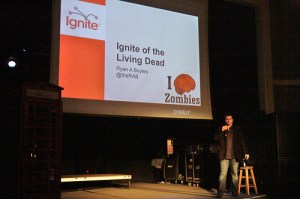
  • Ignite Night of the Living Dead
  • Why My Cat Can Get a Job Before You

Ryan Boyle aka twitter/therabAs you can see, it’s not a tech geek night, unless you call PowerPoint techy. It was fun and educational. It brought together about 500-600 people for a free night of entertainment.

Why would an association want to do this at a conference?

  • It’s a low cost (or free) night of entertainment for attendees where they can hang out and have fun with others.
  • We get to see another side of fellow members.
  • We also get to see members in the spotlight that might not normally get that exposure, a new set of faces.
  • It will be talked about. Believe me, this type of event gets lots of buzz – tweets, Facebook posts and lots of blog posts, lots.
  • It’s a great way to experiment with crowd-sourcing.
  • You can offer something to those members (perhaps younger, perhaps easily bored) who aren’t interested in your usual evening fare.

emcee Zach Ward aka twitter/zachwardWhat does it take?

  • Organizers – Ignite Raleigh was organized by the three man team of OurHashtag with the help of a volunteer coordinator.
  • A large room with a stage, screen and two mics (one for the emcee, one handheld mic for the speaker). The venue last night had some bridge chair seating in the front and in the balcony, but most of it was standing room only.
  • Voting tool – Ignite uses Uservoice on their web site.
  • Registration tool like Eventbrite – Ignite Raleigh was free and they closed registration when they reached the room’s capacity plus an additional no-show allowance.
  • Technical help to run the automated Powerpoint, sound, lights, video camera, livestream (optional) and photography.
  • Volunteers to check folks in, do crowd control and assistance, act as runners and shuffle speakers on and off stage.
  • An entertaining emcee – red tutu not required.
  • Sponsors to cover expenses – Ignite Raleigh ran short videos at the beginning of the night and at intermission and gave them lots of stage/on site love but not the microphone.
  • Brave speakers.
  • Cash bar for the audience.
  • Marketing in conference materials and through social media.

Instead of going to an association awards dinner, I would much rather attend an Ignite-like evening, and I’m a Boomer/Gen Xer (Generation Jones), imagine what your young members would prefer. This is a great alternative to your regular evening programming for those who frankly aren’t interested in what you’re offering, or can’t afford it.

UPDATE: After posting this I learned from Shelly Alcorn that the California Society of Association Executives will be doing an Ignite night at their annual conference. Can’t wait to hear how it goes!

What It Takes to Plan and Host a Conference in Only 46 Hours

In how many hours? Yes, 46 hours, according to my calculations. Sounds impossible? It can be done. As a matter of fact, it happened this week after the American Society of Association Executives (ASAE) had to cancel its annual Technology Conference.

The conference was to start on Wednesday with exhibitor move-in and pre-conference workshops, but DC was still under nearly two feet of snow from the weekend’s storm and was due to get one foot more in blizzard conditions on Wednesday. Airlines were already canceling flights. Some attendees and exhibitors got to town on Tuesday before everything shut down but many were still stuck at home. Even many of those based in DC were still snowbound due to impassable roads and no Metro or train service above ground.

On Tuesday morning ASAE announced via Twitter that it would make a decision by 3:00 p.m. as to whether the conference would be canceled. That’s when the member community started working on Plan B. Later ASAE announced their decision to cancel, the right thing to do considering the conditions. Immediately after, Maddie Grant and Lindy Dreyer of Socialfish blogged about UnTech10, Plan B, an unconference that a team of members had quickly started organizing.

On Thursday, 75 attended UnTech10 in person and 425 attended virtually via a live stream (live webcast) of the programming. I didn’t have the time or budget to go to ASAE’s Technology Conference, but now I was able to “attend” UnTech10 for several hours on Thursday. It was an intellectually stimulating afternoon, time well spent. On Friday, although there wasn’t an on-site component, a full day of webinars was scheduled for the virtual audience.

What do you need to pull off something like this? Here’s what I learned from Maddie and Lindy’s post about organizing it.

You need word of mouth (or mouse) marketing. Most of the marketing for UnTech10 was done via Twitter. A hashtag for the conference was created (#UnTech10) so members could follow that stream of tweets to keep updated. Keep your tweets short enough so that others can retweet them. Vendors also notified clients via email.

Create a Facebook fan page. Although UnTech10 didn’t do this, I saw several references to UnTech10 in my Facebook News Feed as friends shared the original Socialfish blog post.

Create a buzz-worthy email and ask your members to forward it to those they know in the industry or profession. Give clear instructions on how to register and compelling reasons on why they will want to participate. Don’t scare them off by using only technical lingo. This is user-friendly technology, like watching TV!

Contact affiliated or friendly organizations for help in spreading the word. Provide copy and links that they can use to share the news. If you create a sense of buzz and excitement about something, it will go viral if you make it easy for others to help you.

Create a central hub for handouts, schedule, instructions on how to participate and an archive of webcast segments. Content experts were asked to submit program ideas to a wiki. The organizers created a full day of on-site programming (that was live streamed) for Thursday and a full day of webinars for Friday.

Most importantly, you need a community – good relationships with vendors who can help you pull it all together – vendors that will contribute staff to work with you and free services and/or funding for other expenses. This organizing team will take charge and make it happen. According to Maddie, each company on the UnTech10 team had an area to oversee:

You can do this. You can do this if your event is threatened by weather or other unforeseen circumstances. You can certainly do this if you have more time than the UnTech10 team had. They were able to pull it off because they had relationships based on existing trust. Trust that everyone would work together and do their best for the right reasons. The team stepped up and made something excellent out of an unfortunate situation and provided a meaningful experience for our community — an experience that many of us would not have had otherwise.  Because of the generosity and hard work of my fellow members, now I had a chance to grab several hours of education and online networking with other members. This is what a real community does. Does your association have that kind of community?

Trade Show Swag: the Good, the Bad and the Ugly

We had a lively #assnchat on Twitter yesterday about trade show booth giveaways. I volunteered to write a summary, not realizing it would turn into the longest blog post ever. However, there’s lots of good information here from tweets and suggestions I received from Facebook and Twitter friends.

If this post isn’t enough and you want help choosing the best promotional product for your next trade show, check out Heidi Thorne’s book, SWAG: How to Choose and Use Promotional Products for Marketing Your Business.

Many of us agree on what we like to take home from a trade show. Shelly Alcorn raised an important consideration:  “What about sustainability? Can we give out cool things without just creating more junk?” Jeff Hurt recommended “contacting PPAI, the association for promotional products professionals, for green sustainable and unusual ideas.” Some of the greener ideas mentioned were:

  • Seed packets, but not for expos overseas. We like handmade paper seed packets or coasters that bloom into flowers when buried. Joe Flowers mentioned seeds that grow into “a plant with a one-word slogan on them. Very cool and geeky!”
  • Bamboo cutting boards with the exhibitor’s logo etched in — very nice.
  • Reusable shopping bags – one of the group’s favorites. They give the vendor a branding opportunity and fit the green requirement.

Vendors wants to get their brand out there, but we want good design. This is a chance to associate your brand with utility and style. We don’t want an ugly logo coffee mug, but we will take a nicely designed one, perhaps with a discreet logo on the bottom.

Dan Scheeler likes “how #tech10 posted booth giveaways in advance. I admit that will influence which vendors I visit.” 

Here’s what else we like in the food/beverage department:

  • Nalgene-type water bottles
  • Chip bag clips
  • A buddy from my old job at CBIA suggested cork screws or bottle openers, like the kind you can keep on a keychain. Surprisingly no one during the chat made that suggestion. Makes me wonder if those from the housing industry have a stronger need for this type of swag.
  • Neoprene lunch bags
  • Wine cooler bags
  • Insulated travel coffee mugs
  • Nice-looking coffee mugs
  • Drinks, wine or beer get our attention, especially when combined with comfy seating, or bottles of wine with custom labels. Speakers like them too.
  • Mints, power bars, bottled water and good candy help us get through long days at the show.

If swag can double as a gift for kids, it makes it home — rubber duckies, stuffed animals, even caricatures. Parents like the thoughtfulness of handy souvenirs.

Personal items we like:

  • Lip balm
  • Hand sanitizer in little bottles
  • Eyeglass cleaning cloths
  • For a boomer audience, magnifier eyeglasses to read show floor maps with really tiny print
  • Attractive or cool lanyards to reuse at other shows and conferences
  • One of our trade show sponsors provided lanyards with a business card holder attached. We gave them out in our Newcomers Lounge to first-timers. The buzz about them spread on the floor and thousands of folks stopped by to get one. They didn’t have a year on them, just the show name, so we used them for several years.
  • Headshots — useful for social media profiles
  • Magnetic picture frames
  • Digital photos with friends, adding a frame is even better
  • Retractable headphone/earbuds
  • Golf tees and ball
  • Keychain flashlights
  • Brightly colored luggage tags — however, luggage handle wraps got a thumbs-down. Sandra Giarde saw some particularly ugly ones that said, “I’m going to the (name removed to protect the stupid) Show!” Hmm, do you really want to announce you’re here for a convention and a likely mark for price-gouging and god knows what else?
  • Small travel mouse with retractable cord
  • iPod wraps
  • Sturdy messenger or gym bags without any tacky branding
  • Drawstring backpacks

Pens get mixed reviews. Pens with a thumb drive are okay. Dave Coriale said these bobblehead pens are big movers at his booth. A friend gives out the same logoed pens at his booth, and likes them because they double as gifts for kids. Elizabeth Derrico sent me a photo of robot pens she found today at their conference – kids (and some adults) would love those. Shelly summed up the pen issue, “Nobody wants a pen with your company name on it – I mean NOBODY.” Some people can never have enough pens but if you’re doing pens, try to make them cool.

Thumbdrives are popular with some, but others say they already have too many. Ones that stand out are those shaped like the association logo, or “with fun, informative content on it – not just a white paper or sales docs.”

Other popular office items are:

  • Post-its
  • Tape measure or ruler
  • Notepads
  • Highlighters

“The dreaded stress balls” – some like them, many don’t. I think they’re wasteful and will still be around in 2199 when we’re all in the matrix.

T-shirts get mixed reviews. Ray van Hilst said, “Lame t-shirts are bad. Funny or cool ones generate word of mouth.” Other t-shirt advice:

  • Have a mix of sizes so they actually fit attendees and don’t get relegated to the rag pile
  • Keep logos to a minimum. We don’t want to be your walking advertisements.
  • If you make it funny, we might wear it.
  • Matt Baehr suggested “using the threadless.com model on a booth giveaway t-shirt. Have members/clients submit designs. Generate word of mouth that way.”

One of my favorite swag gifts ever was a fleece top from a conference host – best to save that for your VIP clients and prospects.

Matt Baehr’s old association gave out “posters of art masterpieces that were redone to incorporate modern AV (think Whistler’s mother with an iPad). Those posters are still talked about and are in many members’ lobbies.” They used to sell them but after a few years started giving the remaining inventory away. How cool is that?

Ray reminded us that sometimes “an experience counts as a giveaway too. Chair massages get people to stop and relax,” or hand “facials.” At ASAE’s Annual Meetings, the St. Louis Build a Bear booth is always a huge hit, combining an experience with a giveaway. An experience/giveaway also happens at CalSAE’s Seasonal Spectacular every December. Marriott takes orders on site for personalized clay Christmas tree ornaments. It’s wildly popular and their booth is always crowded with attendees watching their ornament being made.

Peter Romeo told me about a conference that gave attendees Express Mail postage to ship their conference binders home. It was a sponsored perk.

Experiences, rather than giveaways, might be a more sustainable option too. Toni Rae Brotons told us about vendors at their show who did a ring toss game. The association donated money to a charity based on where the ring landed.

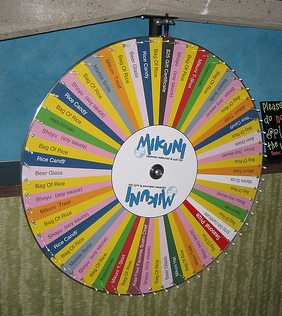
Helen Mosher gave us a heads-up that her colleague Maryann Lawlor was tweeting about swag from their conference. At one booth if you guessed the correct number of M&Ms in a jar, you could win a Snoopy lunchbox. In another you won prizes playing Wheel of Fortune. I’ve seen this at a restaurant in Sacramento – you spin the wheel on your birthday and have a chance at gift cards (best prize) or a bag of rice (worst but practical).

What kind of swag do you like taking home from trade shows? What do you actually use? On the contrary, what do you think is a big waste of money and resources?


If your company plans to send pre-show and post-show emails to conference or trade show attendees, don’t make the mistakes that most exhibitors do. Read these two posts to learn how to send emails that association executives will value:


Enter your email address to subscribe to this blog and receive notifications of new posts by email.


(This post includes an Amazon affiliate link. I receive a small commission if you click on the link and purchase the product.)

Learning to Talk and Walk at the Same Time

A Twitter friend of mine, Jeff Bailey, something of a presentation guru himself, told me about a two-day speaking class, Powerful Persuasive Speaking, taught by Alan Hoffler. I don’t think any of us can ever learn enough about the science and art of communicating, so I quickly signed up.

I became more aware in a few hours of my speaking shortcomings and strengths than I ever could have imagined, and then spent the next two days learning how to correct my bad habits (that I didn’t even know existed!) and become a better communicator. Our teacher Alan was a walking talking example of an engaging and effective speaker and he was also a fun, patient and knowledgeable instructor.

We had two rules to bear in mind:

  • It’s not about me, it’s about the audience.
  • Mind the gap — there’s a huge difference between what I’m feeling while speaking and what the audience is experiencing.

I definitely knew the first rule, although there have been a few times when it was hard to get out of my own worrying head and into the audience’s, especially when things out of my control disrupt my carefully prepared plan. I had experienced the second rule (the gap) and never quite believed it, but now I have the film to prove its truth. Sometimes if our mind is in turmoil and we think we are absolutely dying up there, strangely enough we can appear poised and confident to the audience – a huge gap in perception versus reality. Why do we appear so confident? It’s because we have the skills – either learned or innate. We are connecting to and engaging the audience. It seems almost magical at times.

We learned about posture, arm placement, gestures, eye contact and movement. Yes, it is hard to walk and talk at the same time! It actually takes practice to do it in an effective way. Thankfully, we learned that much of this is similar to muscle memory. If we practice the skills, soon they become natural to us and we can build our presentation on top of them. I thought back to when I learned to figure skate and the hours I practiced school figures using different edges. Boring! But those skills became part of my muscle memory. Without having them as a base I couldn’t have done the pretty spins and jumps.

Another thing happened in class, something that wasn’t included in the program description. We started as a group of eleven strangers who were feeling a bit nervous, anxious and vulnerable about speaking, totally unprepared as to content (improvising in fact) in front of each other, and being filmed while doing it. By the end of the second day, we had bonded as a group that went through a discovery and learning process together. We felt comfortable pointing out each other’s mistakes and strengths. We became interested in each other’s professional paths. Some of us spoke of meeting regularly as a group to continue practicing our burgeoning skills.

Learning and growing is always more rewarding when doing it with others – whether it’s a class, study group, discussion group, workshop or retreat. Seeing the excited spark in someone’s eyes or noticing how their body moves to the edge of their seat leaning into a conversation – that can be infectious in the best way possible. I’ve always been motivated by opportunities to learn and find ways to make it a regular part of my life. How do you find ways to learn and grow with others?